

Riddles have a way of sneaking into your mind and refusing to leave. They force you to think differently, make you pause, and challenge the assumptions you didn’t even know you were making. Today’s brainteaser has stumped thousands online, and it’s deceptively simple.
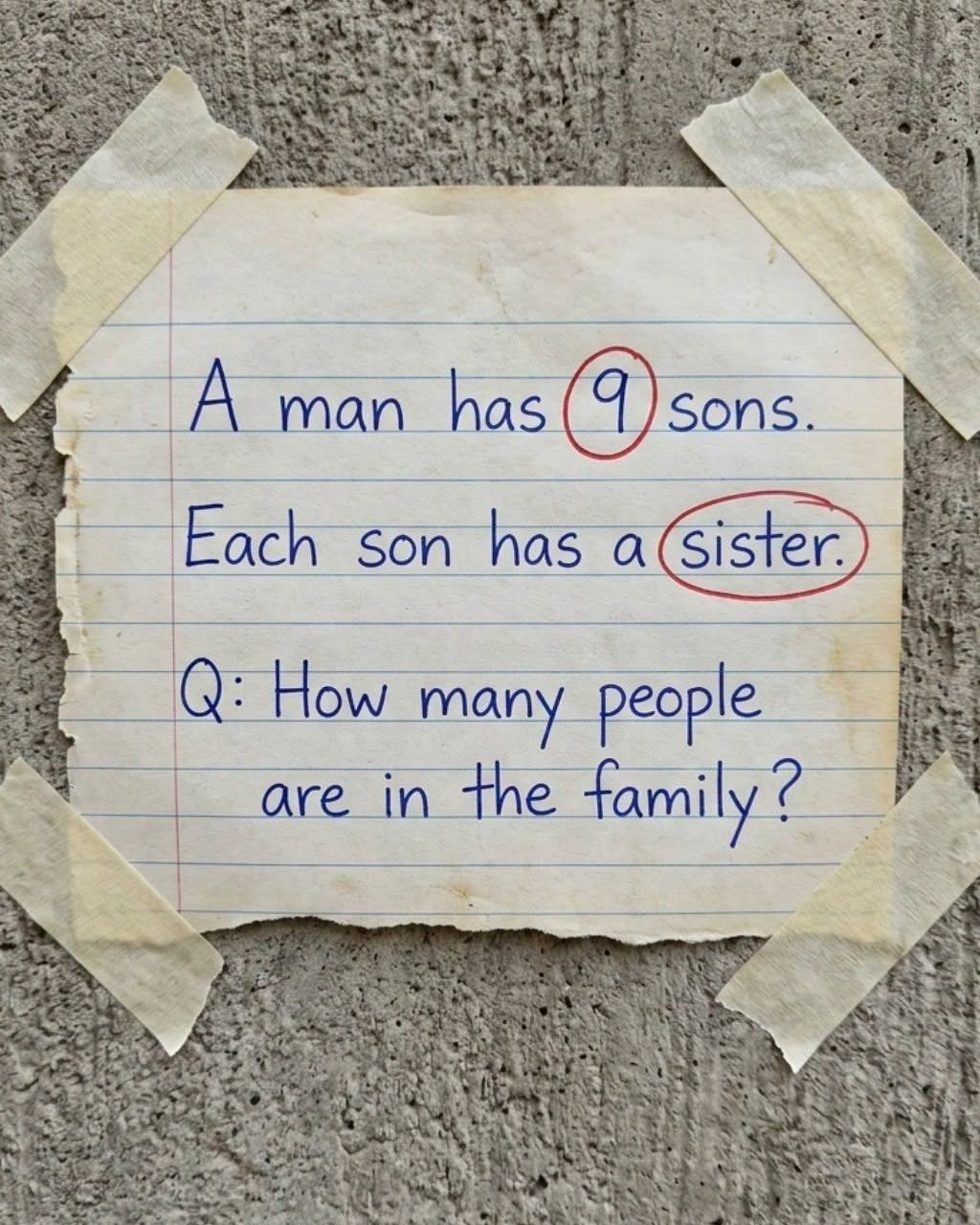
A man has 9 sons. Each son has a sister. How many people are in the family?
Take a moment. Don’t rush. Let your brain consider the possibilities. It feels straightforward at first, doesn’t it? Nine sons, each with a sister… you might immediately start calculating.
Some people jump to: 9 sons + 9 sisters + 1 father = 19 people. But that’s where the trap lies.
The riddle never said each son had a different sister. It only said:“A man has 9 sons. Each son has a sister.”
Think carefully. Could all nine sons share the same sister? Yes. That’s the trick.
So let’s break it down slowly:
- 9 sons – obvious.
- 1 sister – the sibling shared by all sons.
- 1 father – the man who is the parent of these children.
Add them together: 9 + 1 + 1 = 11 people.
It’s that simple… once you’ve read it carefully.
Why So Many People Get It Wrong
The phrasing tricks our brains. When it says “Each son has a sister,” our instinct is to imagine each son with a separate sister, multiplying in our mind. We assume uniqueness where there isn’t any.
This riddle is a classic example of why paying attention to language matters. It’s not just a math problem—it’s a test of your reading comprehension, logic, and ability to resist assumptions.
It reminds us of something important in everyday life: not everything is exactly as it appears at first glance.
Step-By-Step Solution
Continued on next page//